Français
 Deutsch
 Italiano
 Español
 Čeština
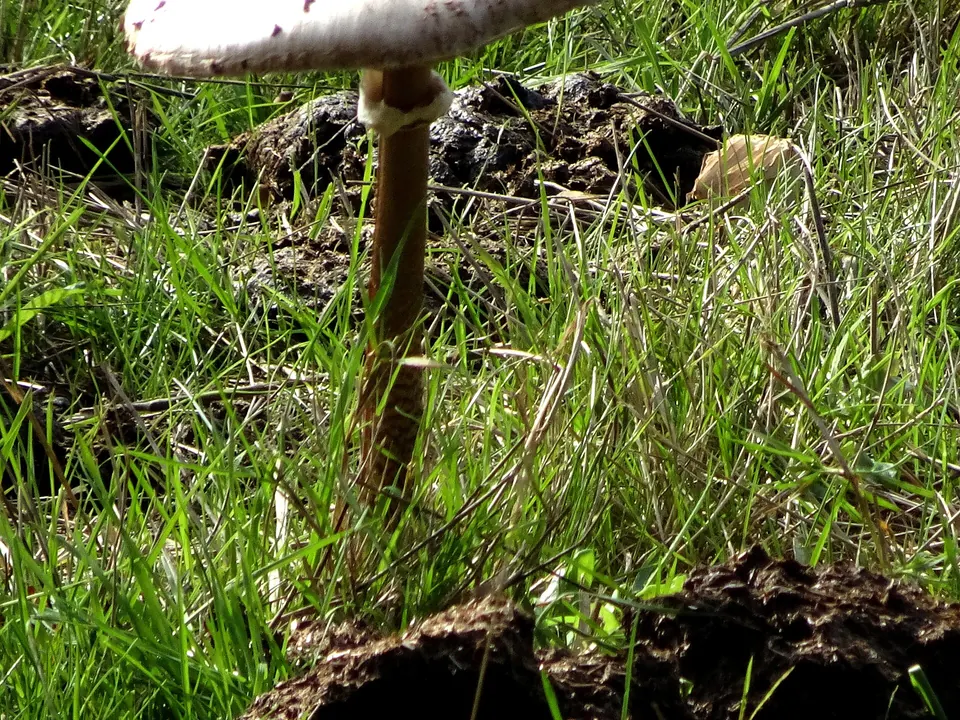
Recognising the parasol mushroom
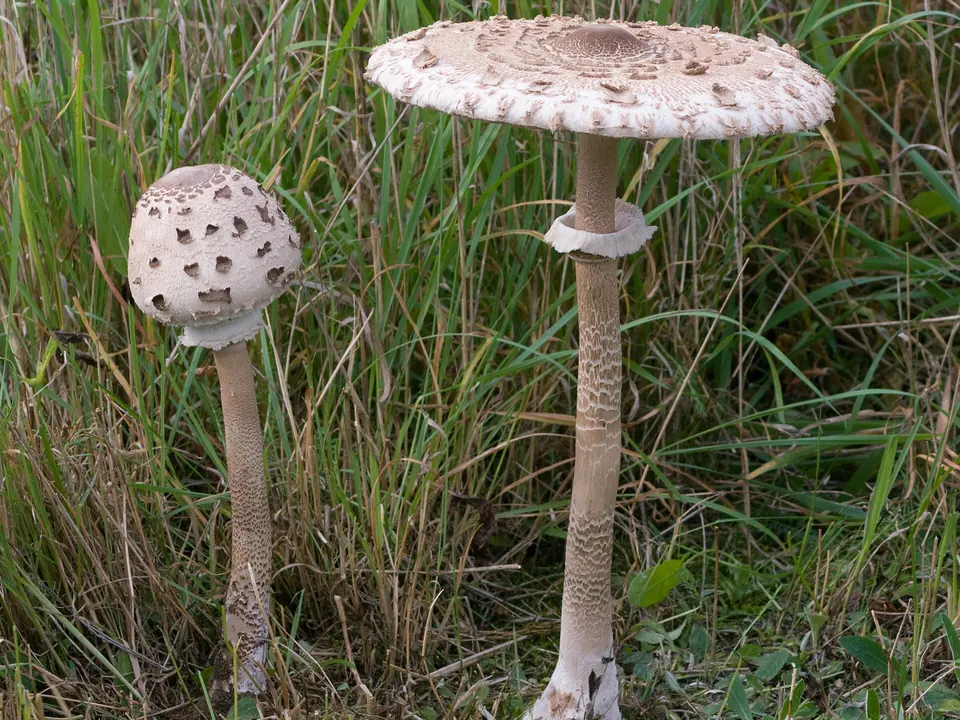
The parasol mushroom (Macrolepiota procera), also called the tall lepiota, is a large grassland mushroom, easy to spot from afar when mature:
- large cap, first egg-shaped then spreading “like a parasol”, with a small brown bump at the centre, covered in brown scales on a cream background;
- very tall, slender stem, swollen at the base, marked with brown zigzag banding like snakeskin, which comes away from the cap like a stem from a ball joint;
- double, movable ring: it can be slid along the stem;
- white, crowded gills that do not touch the stem (they stop short of it); white spore print;
- white flesh, mild nutty smell.
Only large, fully developed specimens are picked, never small or young ones.
Look-alikes
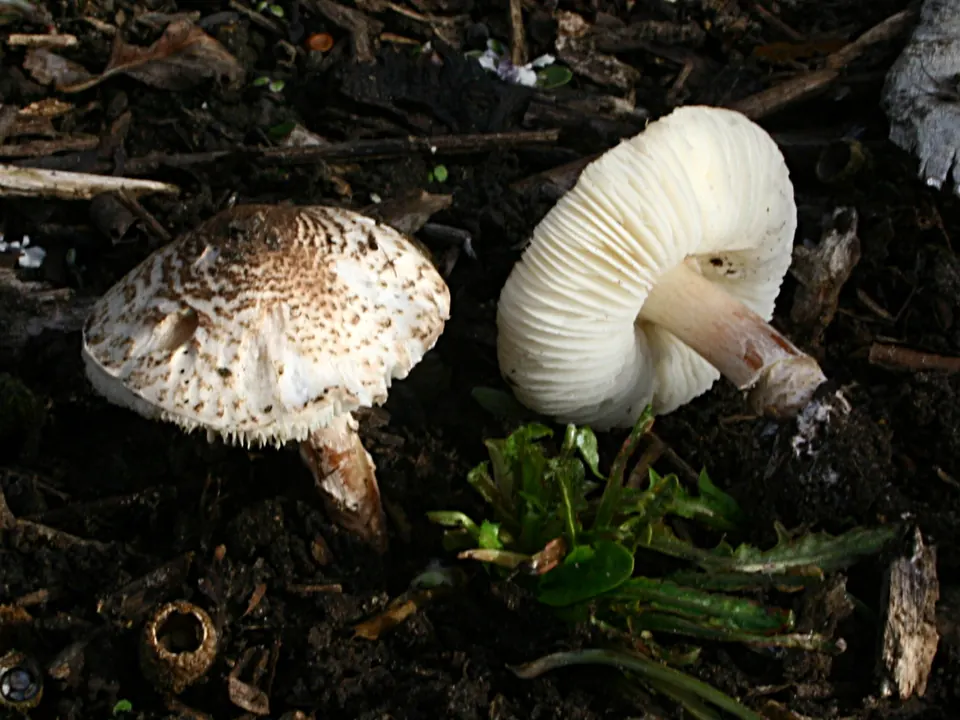
Small lepiota with a cap a few centimetres across, pinkish-brown scales on a pale background, smooth stem with a fleeting ring or a mere trace. Lawns, parks and gardens. Contains amatoxins: deadly, with delayed signs. Only large specimens with a banded stem and movable ring are parasol mushrooms.
?Photo Strobilomyces, CC BY-SA 4.0, Wikimedia Commons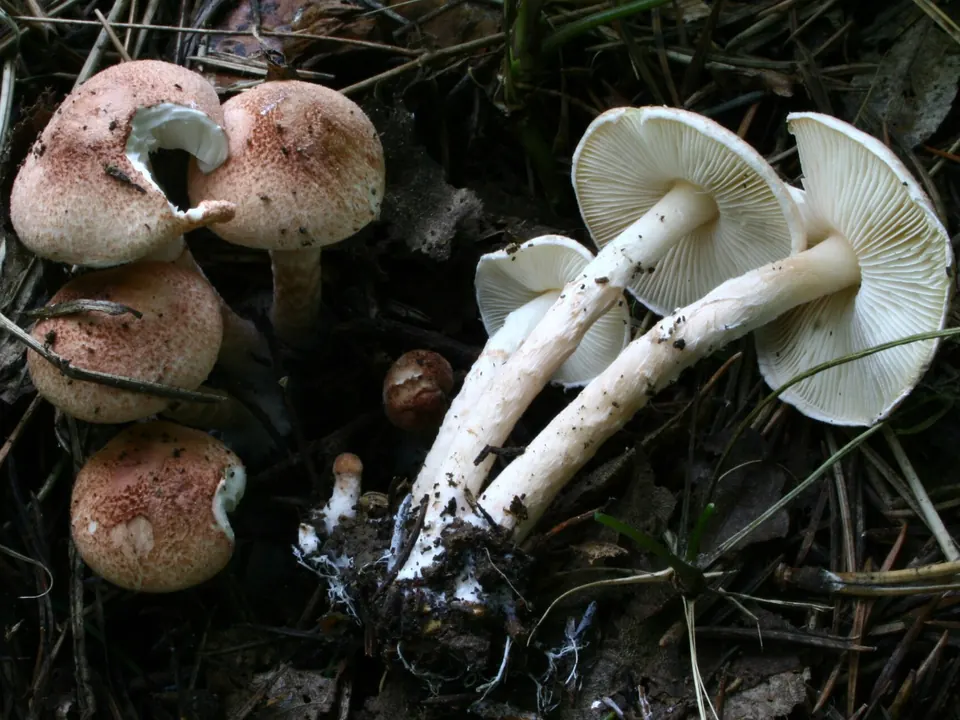
Small pinkish to pinkish-brown lepiota, small scaly cap, thin stem without banding. Lawns and light undergrowth, often in autumn. Amatoxins: deadly. Rule: never pick a small lepiota.
?Photo Strobilomyces, CC BY-SA 4.0, Wikimedia Commons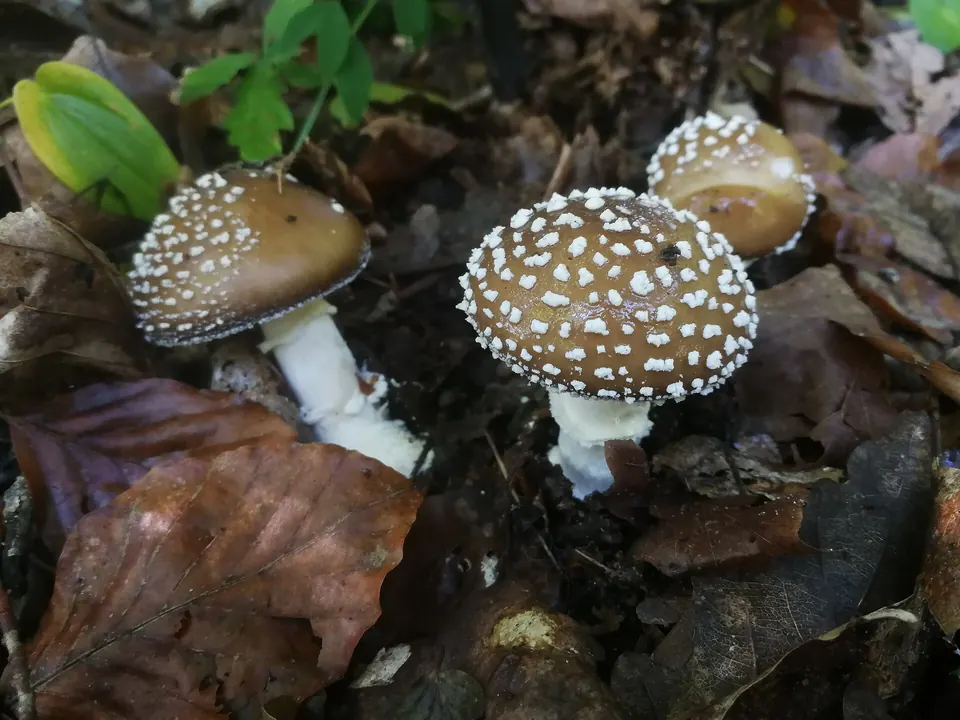
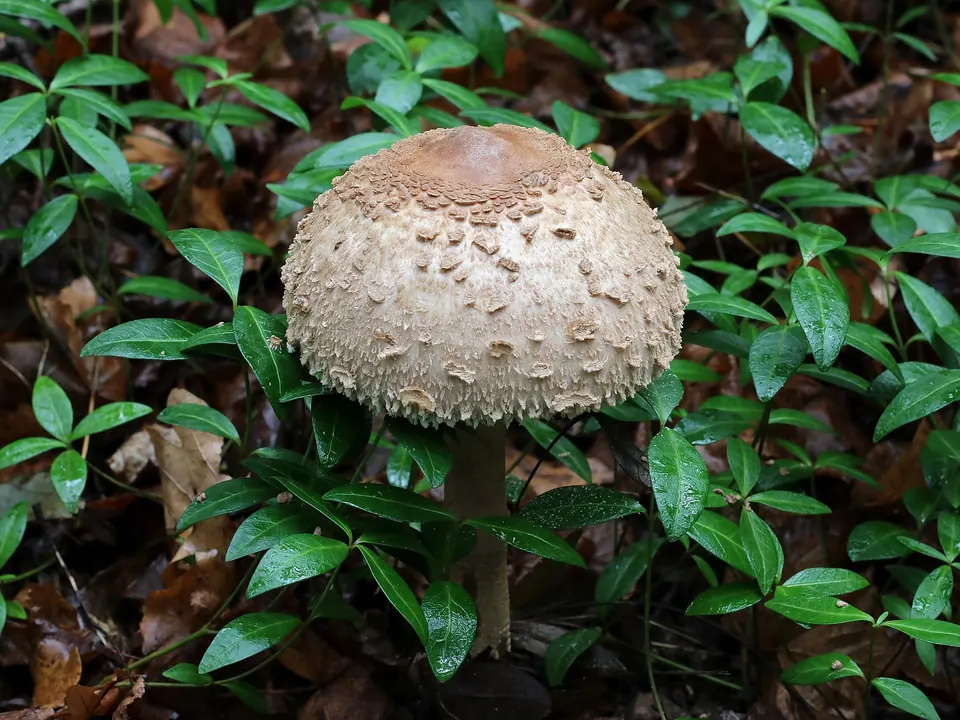
When young, its brown cap is speckled with white warts and can resemble that of a budding parasol mushroom. But the stem is white and smooth, with a rolled volva at the base, and gills under a fixed ring. In forests. Neurological poisoning (confusion, drowsiness).
?Photo Tomasz Sobczak, CC BY-SA 4.0, Wikimedia Commons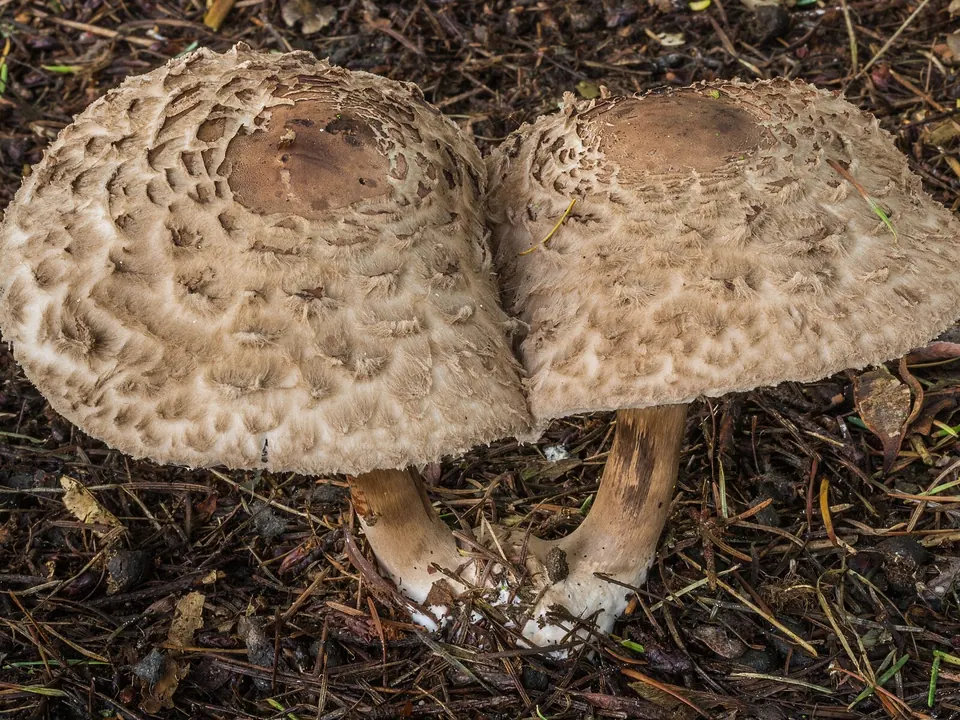
Wide cap with large brown scales, smooth stem (no banding) with a bulb-like swollen base, flesh that reddens when cut. Mainly under trees, in woods and parks. Poorly tolerated by some people; not to be confused with the parasol mushroom with its banded stem.
?Photo Dominicus Johannes Bergsma, CC BY-SA 4.0, Wikimedia CommonsSimple rule: only eat large specimens with a brown-banded stem and a movable ring. Any mushroom of the same kind with a small cap, a smooth stem or a fixed ring is not a parasol mushroom: some small lepiotas are deadly. At the slightest doubt, do not pick, and have your harvest checked by a pharmacist or a mycological society.
Small lepiotas (Lepiota brunneoincarnata, L. josserandii…) contain amatoxins, the toxins of the death cap. The first digestive signs appear late and can make you think of a simple stomach bug while the liver is already affected: if you feel unwell after a meal of mushrooms, call 112 immediately (999 in the UK; 15 in France) or a poison centre.
Habitat: where to look
The parasol mushroom has no host tree: it decomposes organic matter in the soil (a saprotrophic mushroom) and does not need trees to grow. It is found mainly where there is grass and light.
Which habitat
- Meadows and pastures, grassy fields, clearings, open undergrowth and light broadleaf woods, track verges, banks, edges, parks and hedgerows.
- Dense, dark forests, ploughed crops and built-up areas do not suit it.
Terrain and soil
- No precise altitude or aspect is established by the sources consulted: it follows open habitats, from lowland to hills.
- According to the summary cited below, rather on siliceous (non-calcareous) ground. Sporalo does not take pH into account for it.
Microsites: where to look
- Alone, in troops or in circles (“fairy rings”): spot the large parasol caps from afar in short grass, then look around.
- Woodland borders, clearings and grassy banks.
- A meadow or edge that has produced may produce again: make a note of the spot.
Caution: deadly small lepiotas can grow on the same lawns and edges. The place is not enough: only pick large, complete parasol mushrooms (see “Look-alikes”).
Season and triggers
A few specimens appear from summer onwards, but the main season runs from late summer to early autumn, after rain and when nights start to cool: public observations in France are concentrated in September and October. It fears frost. Its thin cap dries out quickly: pick it young and eat it without delay.
Sources
The months and periods mentioned are rules of thumb and a summary of citizen-science observations in metropolitan France (GBIF), not quantified results from a study: the site's calculation is based on the weather (see the method). No published study was retained to support figures on the parasol mushroom: this page therefore gives none.
- Vellinga E.C., de Kok R.P.J., Bruns T.D. (2003). Phylogeny and taxonomy of Macrolepiota (Agaricaceae). Mycologia 95(3):442-456. doi:10.1080/15572536.2004.11833089: the parasol mushroom (M. procera) and the shaggy parasol (Chlorophyllum rhacodes) belong to two distinct groups, separated by the structure of the cap and stem and by the spores.
- Varvenne D. et al. (2015). Amatoxin-containing mushroom (Lepiota brunneoincarnata) familial poisoning. Pediatric Emergency Care 31(4):277-278. doi:10.1097/PEC.0000000000000399: family poisoning in Marseille by a small amatoxin-containing lepiota, with liver damage; the initial gastroenteritis can delay treatment.
- Long P. et al. (2020). Determination of amatoxins in Lepiota brunneoincarnata and Lepiota venenata by high-performance liquid chromatography coupled with mass spectrometry. Mycobiology 48(3):204-209. doi:10.1080/12298093.2020.1765718: L. brunneoincarnata contains α- and β-amanitin.
- Vendramin A., Brvar M. (2014). Amanita muscaria and Amanita pantherina poisoning: two syndromes. Toxicon 90:269-272. doi:10.1016/j.toxicon.2014.08.067: panther cap poisoning mainly causes drowsiness, even coma.
- Maillot A. et al. (2024). Chlorophyllum molybdites poisoning on Reunion Island. Toxicon 237:107554. doi:10.1016/j.toxicon.2023.107554: this large green-gilled lepiota causes an irritant gastrointestinal syndrome.
- Andrew C. et al. (2018). Explaining European fungal fruiting phenology with climate variability. Ecology 99(6):1306-1315. doi:10.1002/ecy.2237: temperature is the main driver of autumn fruiting.
- Wikipédia (French), « Coulemelle » (secondary summary, consulted in November 2026). fr.wikipedia.org/wiki/Macrolepiota_procera: saprophyte with no need for mycorrhizae; open undergrowth, light broadleaf woods, pastures, clearings, fields and meadows; troops, fairy rings or solitary; rather on siliceous ground.